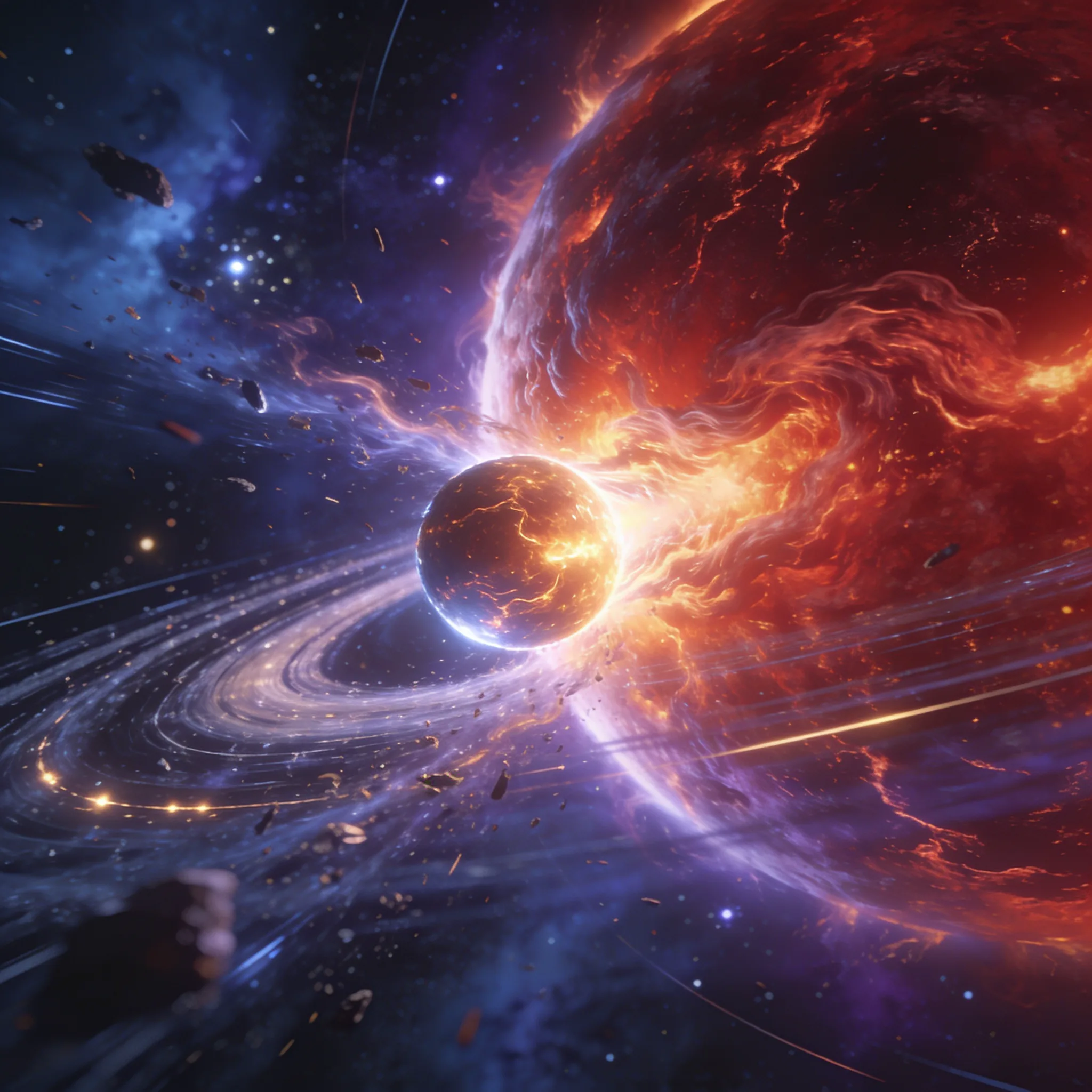
Astronomers have successfully monitored a phenomenon predicted by science but never before observed directly: a giant star consuming its companion. The event took place in the Andromeda galaxy, located approximately 2.5 million light-years from Earth, allowing researchers to reconstruct different stages of a stellar merger.
The system received the nickname Bao and consisted of two stars of significantly different sizes. The larger star, Big Bao, had approximately seven times the mass of the Sun and a radius 350 times greater than our star. Its companion, Little Bao, possessed about 70% of the solar mass. The discovery was detailed in a study published in the journal Nature on Wednesday, November 18.
How one star swallowed another
Researchers identified changes in the system's behavior starting in 2018. At that time, the luminosity of the larger star began to increase gradually. In 2023, observations made with NASA's NEOWISE space telescope and the WINTER instrument at Palomar Observatory in California helped identify that something unusual was occurring. The hypothesis was that the smaller star had begun to approach the giant.
As it advanced toward the interior of Big Bao, the companion produced friction, heat, and light, explaining the gradual brightness increase observed by astronomers. The process developed over approximately seven years. According to researchers, the two stars orbited each other for thousands of years before the smaller one came into contact with the surface of the giant.
In October 2025, the system presented a large explosion of light. The phenomenon attracted the attention of scientists and was followed by instruments including Gemini North and James Webb telescopes, as well as the Swift observatory. The James Webb Space Telescope observed the system 47 days after the explosion, providing important information to reconstruct what had happened.
Explosion happened in just one week
One of the most surprising aspects of the phenomenon was the speed at which the explosion developed. Nadia Blagorodnova, a researcher at the University of Barcelona and co-author of the study, noted that scientists expected an explosion involving such an extensive star to take years to reach maximum brightness. However, the luminosity increase happened rapidly: within just one week, the event reached its peak.
Researchers estimated that the explosion launched material equivalent to approximately 10% to 20% of the Sun's mass into space. Despite observations indicating that Big Bao consumed its companion and that the two stars may have merged into a single object, scientists have not ruled out another possibility.
Viraj Karambelkar, the lead author of the study, stated that the two stars may have survived the episode but began occupying a much closer orbit. The team intends to continue monitoring the system after the effects of the explosion diminish. New observations could help determine exactly what happened to the two objects.
What it means
This discovery represents a significant advance in understanding stellar mergers, phenomena predicted for decades but extremely difficult to observe in real time. By confirming this process, astronomers now have a concrete case study to refine models of how binary star systems evolve when they become unstable.
For readers interested in astronomy, this observation demonstrates the capability of modern telescopes like James Webb to capture dynamic cosmic events across vast distances. It also highlights that some stellar processes occur much faster than previously assumed, challenging existing theories about the timeline of such interactions.
Uncertainty remains regarding the final fate of the stars involved. Whether they fully merged or simply settled into a tighter orbit will require continued monitoring. Future observatories, such as the Nancy Grace Roman Space Telescope and the Vera Rubin Observatory, are expected to help find similar cases.
Would you trust future space telescopes to reveal more of these hidden cosmic collisions, or do you worry we might be missing other dangerous events happening nearby?